“Oh, young hearts run free
They’ll never be hung up, hung up like my man and me, my man and me
Oh, young hearts, to yourself be true
Don’t be no fool when love really don’t love you, don’t love you”
Thirty years have passed since Baz Luhrmann unleashed his visionary cinematic take on William Shakespeare’s Romeo and Juliet, a film as messy as it is stunning. In doing so, Luhrmann helped ignite a passion for Shakespeare’s work previously unseen among many of us coming of age at the time. And for those of us living in culturally dry areas, it served as a filmic gateway to the concepts of utter flamboyance and spectacle. William Shakespeare’s Romeo + Juliet, Luhrmann’s compromise of a full title, hit during the mid-’90s sweet spot in which pop art enjoyed a smattering of the mainstream without losing its intensity and indie merit. This film, essentially a “Shakespeare for the MTV generation,” boldly took its youthful energy where stuffy English teachers would not dare to go. It’s a punk version of the star cross’d lovers’ tale to say the least, capturing a sloppy rebellion that’s a testament to young love and high drama.
Romeo + Juliet stands as perhaps the most teenaged film in history, a chaotic, hyper-stylized explosion tailored to Gen-X youth raised on rapid cuts, music videos, and a craving for exuberance over restraint. It translated Shakespeare’s 400-year-old tragedy into a contemporary Verona Beach (a sun-soaked, gang-ridden hybrid of Miami and Mexico City), swapping swords for guns with the Elizabethan verse accentuated by a thumping soundtrack. The film’s frenetic editing, sensory overload, and embrace of excess mirrored the era’s cultural pulse: a mix of counter-culture rebellion, glossy music videos, and coming-of-age angst. It became a cultural reset, proving Shakespeare could be lavishly entertaining and accessible without diluting its core. While critics like Roger Ebert dismissed it as a “mess,” calling it confusing with shouted dialogue and mismatched styles, the film topped the box office and resonated deeply with teens. Of course, Ebert, as forward-thinking as he sometimes was, was still an old establishment dinosaur and would not understand (“The desperation with which it tries to ‘update’ the play and make it ‘relevant’ is greatly depressing.” Right.). But for teens, its bouncing soundtrack, MTV-style cinematography, and all-star young cast (Leonardo DiCaprio and Claire Danes) made it irresistible (with no signs of desperation), turning it into a gateway drug to the Bard for a generation glued to music videos and high-drama romance.
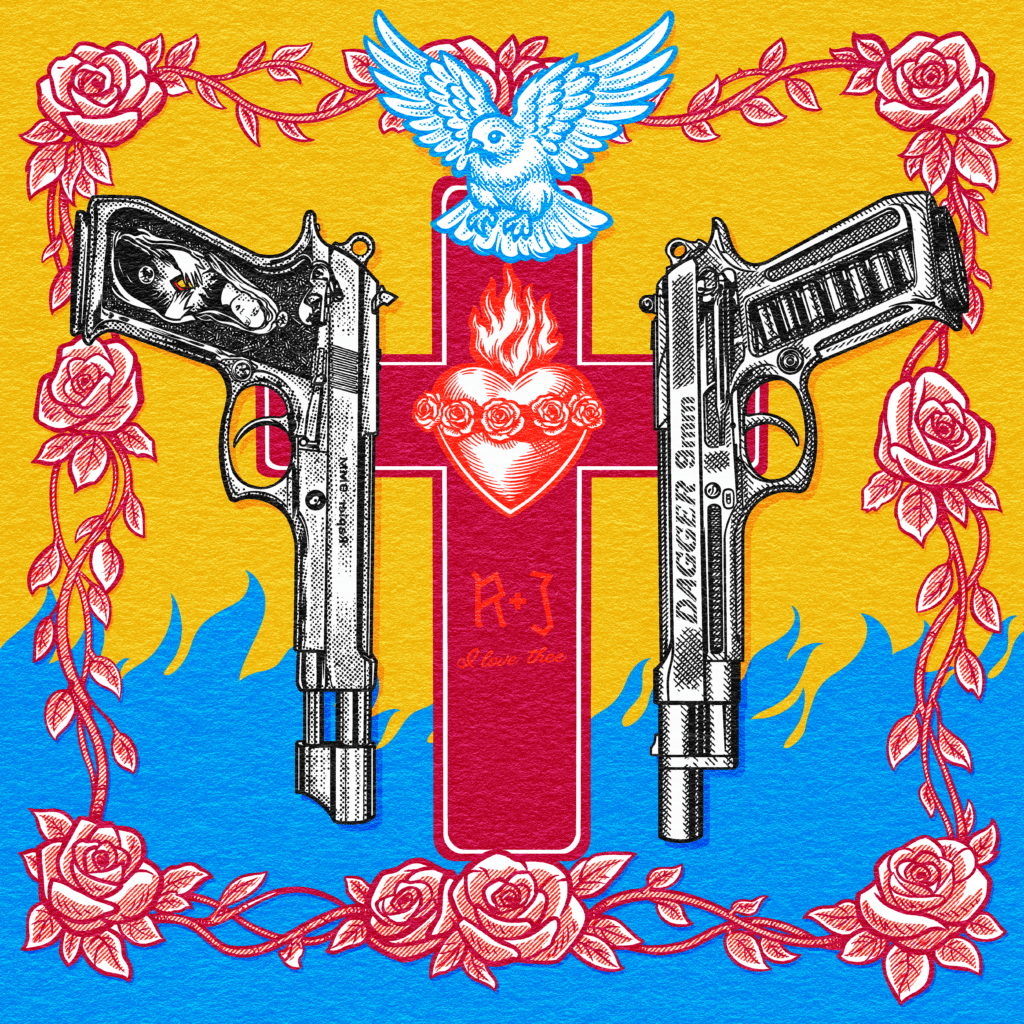
The film’s bold reimagining amplifies the messiness of young love, blending impulsiveness and rebellion with religiosity in a way that feels both sacrilegious and seductive. “Designer Catholicism” permeates the visuals: neon crosses, guns engraved with idolatry, Latin-inspired choral arrangements, and baroque flourishes on outfits. Montagues sport Hawaiian shirts hand-painted with palm trees, religious symbols, and flaming hearts, while Capulets wear ornate Western gear with Latin crosses, leather vests, and steel-plated pointy boots. Juliet dresses as an angel at the masquerade ball, her gown embroidered with hidden script lines (“Oh, speak again, bright angel”) that evoke heavenly calm and beauty. Romeo’s wardrobe leans toward high fashion with custom Prada suits that contrast the Montague boys’ colorful chaos. The detail given to all the characters’ fashion seals the film’s teen appeal, locking in these looks as genuinely prom-worthy and turning them into cultural touchstones.
But beyond the wardrobe and aesthetic flair, the “updated” Romeo + Juliet film Ebert called “depressing” has more to say in its characterizations than just presenting a tragic love affair. For one thing, in hindsight, the film captures a distinctly 1990s approach to gender that resonated with young audiences: one that keeps core stereotypes largely in place while adding an edgier, more flamboyant twist that reflects the era’s growing willingness to play with boundaries. Despite traditional ideas of what makes a man or woman “masculine” or “feminine” still holding strong cultural weight, filmmakers began to validate the MTV generation’s mix of rebellion and spectacle, which started pushing pop culture toward more visual excess and irony. The result is a film that feels subversive without delivering a clear, stated message. Instead, it amplifies stereotypes for dramatic effect, uses flamboyance as stylistic energy, and lets the chaos of youth reign supreme.
While the film’s visual and musical exuberance made Shakespeare feel electric and immediate to 1990s audiences, its treatment of gender is equally striking. Luhrmann keeps the core stereotypes of masculinity and femininity recognizable and familiar enough that teens in the mid-’90s could instantly understand who was the tough guy, the romantic lead, or the beautiful heroine, yet he presents them with a bold, almost theatrical exaggeration that reflects the era’s growing appetite for edgier, more stylized expressions of identity. In this MTV-era retelling, gender becomes part of the spectacle: masculinity is performed in three distinct but complementary ways through Mercutio’s splashy confidence, Tybalt’s aggressive machismo, and Romeo’s sensitive romanticism, while Juliet’s romantic femininity anchors the story’s emotional center. These archetypes are amplified for dramatic effect, using a uniquely 1990s disposition to make the age-old tragedy feel fresh and unmistakably of its moment.
The film takes significant creative liberties with Mercutio, portrayed by Harold Perrineau, infusing the character with elements that many viewers and critics now interpret as queer. Mercutio stands out with the film’s most extravagant edge: his drag performance at the Capulet party, donned in a sparkling silver skirt, wig, and lipstick, and wildly lip-syncing to “Young Hearts Run Free,” is pure spectacle. In the ’90s context of rising club culture, drag shows in media, and MTV’s playful excess, this reads as carnivalesque fun: a temporary inversion of norms during the chaotic party, where hierarchies flip, and self-expression is uninhibited. It highlights Mercutio’s confident, larger-than-life personality against the more rigid masculinities around him, adding visual energy and rebellion. But it’s not framed as a deep statement on gender or sexuality; rather, it’s flamboyant showmanship. Perrineau’s athletic charisma turns it into a moment of joyful defiance, where Mercutio embodies freedom from rigid norms (that old Shakespearean adage “to thine own self be true”). Scholars describe this as Bakhtinian carnivalesque: a temporary and festive inversion of hierarchies, allowing gender play without locking Mercutio into a fixed transgender or gay identity. It’s extravagant, yes, but tied to the party’s chaotic energy rather than a singular statement on sexuality. This read fits the era’s growing comfort with gender-bending aesthetics without spelling out any explicit challenge to specific norms.
However, these choices do amplify non-normative vibes, but as such, they stem more from Luhrmann’s theatrical, MTV-inspired aesthetic than from a definitive textual claim of homosexuality in Shakespeare’s play. Luhrmann himself once asserted that Mercutio’s gay identity as “in the text… there’s no question he is [gay],” but scholarly analysis often finds little direct evidence in the original to support this as explicit rather than interpretive. The film’s portrayal, then, is a bold modern lens that celebrates fluidity and rebellion, rather than a strict “queer coding” of the character. This contrasts sharply with Tybalt’s aggressive machismo, emphasizing Mercutio’s fluidity as a form of resistance. When Tybalt hurls the homophobic-tinged insult “Mercutio, thou consort’st with Romeo?” Mercutio responds with phallic bravado (brandishing his gun), turning the slur back on itself. It’s a moment of confident pushback, but it plays as witty defiance more than confirmation of homosexual lust or desire.
In Shakespeare’s text, Mercutio’s bond with Romeo is intimate and teasing, a mix of affectionate banter, sharp wit, loyalty, and frequent sexual innuendo that reflects the kind of ribald, brotherly camaraderie common in Renaissance male friendships. This dynamic shows Mercutio as Romeo’s confidant and foil: he knows Romeo deeply enough to mock his moods and romantic obsessions relentlessly, while Romeo often responds in kind or plays along. That said, homoerotic readings rely on interpretation rather than overt romance. Luhrmann heightens this: physical closeness, protective rage, and subtle pining add emotional depth. Mercutio’s death scene, cradled by Romeo and cursing both houses, carries extra weight, blending grief, betrayal, and the tragedy of overtly masculine bonds in a feud-driven world. Some analyses see this as queering the heteronormative core of Romeo and Juliet’s love, positioning Mercutio as a foil who disrupts tidy categories.
Yet many scholars caution against overreading: the play lacks clear evidence of homosexuality, and Luhrmann’s choices are performative flair, not textual fidelity. Perrineau himself noted the drag elements surprised him at fittings, and his performance aimed for naturalism amid the excess. The result feels exuberant and subversive without a hunger to stick a label on it. It’s more about embracing spectacle, self-expression, and rebellion against toxic masculinity than insisting on a specific orientation. Perrineau notes, “Mercutio is full of great passions. Of the badasses that could be out there, Mercutio was the baddest ass there was. And wearing a skirt was no problem for him, because if you were going to challenge his manhood, he was ready for that, as well. That’s sort of the stuff we played with. It was really quite awesome.”
In the mid-’90s, this portrayal was bold: a Black, gender-bending Mercutio in mainstream cinema brought visibility and complexity, especially amid rising discussions of post-AIDS queer narratives. But also, we really didn’t think too much of it back then. Sure, it unapologetically challenges stereotypes and gives new life to stodgy old literature, but Mercutio’s freedom of expression is more a casual celebration of nonconformity than a clear ideological message. The film’s religious imagery, juxtaposed with said nonconformity, does hint at acceptance amid judgment, but again, it’s subtle, not preachy. Ultimately, Mercutio’s “queer subtext” in Luhrmann’s film is resonant, but it is interpretive and stylistic rather than definitive. It is vibrant, defiant, and true to the MTV generation’s spirit of exhibition and authenticity. Thirty years later, it still sparks debate, proving the character’s enduring power to challenge norms without needing to pin him down.
Tybalt, portrayed by John Leguizamo, serves as a stark embodiment of exaggerated masculinity, channeling intense Latin machismo through his possessive demeanor, aggressive posturing, and eagerness to fight. This over-the-top portrayal amplifies Shakespeare’s original character — known as the “Prince of Cats” for his feline ferocity — into a hyper-stylized figure that drives the film’s themes of feuding loyalties and impulsive violence. Luhrmann’s choices heighten Tybalt’s machismo as a foil to the more flamboyant and romantic personalities around him, making him a catalyst for the tragedy without diluting his role as a fiercely protective family enforcer.
Tybalt’s hypermasculinity is immediately evident in his striking visual design, which blends demonic flair with Western bravado. At the Capulet ball, he arrives dressed as Lucifer, complete with red devil horns, a tailored black suit, and silver cat-heeled boots that signify his predatory nature. This “cat” motif extends to the engravings on his guns and ornate accessories, symbolizing a sleek, lethal prowess. His wardrobe, featuring leather vests and religious icons, merges Catholic symbolism with a gunslinger aesthetic, underscoring his role as the Capulet gang’s vigilant guardian. Leguizamo’s performance leans into this excess: Tybalt moves with deliberate swagger, his voice laced with snarls and taunts, always poised for confrontation. In the opening gas station brawl, he ignites the chaos with a dropped cigarette and a defiant grin, his body language radiating dominance and control. These elements portray an amplified masculinity that’s performative and ritualistic, where every gesture asserts authority and territorial claim.
Tybalt’s masculinity manifests most vividly in his interactions, particularly his rivalry with Mercutio and his protective stance toward the Capulets. He views himself as the family’s shield, especially possessive of Juliet’s honor, evident in his outrage at Romeo’s presence at the ball (“What dares the slave come hither?”). This possessiveness stems from a rigid code of loyalty, where masculinity means defending blood ties at all costs, even if that points to escalating minor slights into deadly duels. His clash with Mercutio highlights this: when Mercutio mocks him, Tybalt responds with steely restraint at first, then unleashes precise, feline-like acrobatic violence in their swordfight-turned-gun battle. Yet this intensity also humanizes him; his grief over the feud’s toll adds layers, showing hypermasculinity as both a strength and a tragic flaw that blinds him to reconciliation. Tybalt’s machismo is a product of the ultra-violent, honor-bound society, making him a fervent enforcer rather than a cut-and-dry villain. Thirty years later, this portrayal resonates in discussions of masculinity in media, offering a nuanced look at how overzealous protectiveness can fuel both heroism and downfall in stories of love and conflict. In contrast to Romeo’s romantic impulsiveness or Mercutio’s flamboyant confidence, Tybalt’s version of manhood is unyielding and hierarchical, prioritizing clan over individual desire. This dynamic propels the plot: his killing of Mercutio forces Romeo’s retaliation, sealing the lovers’ fate and illustrating how exaggerated masculine codes perpetuate cycles of retribution.
Romeo Montague, played by a young Leonardo DiCaprio, embodies a form of romantic masculinity that blends poetic sensitivity with impulsive passion, setting him apart from the more aggressive or fluid masculinities of characters like Tybalt and Mercutio. This portrayal reimagines Shakespeare’s lovesick youth as a brooding, dreamlike figure in a hyper-modern Verona Beach, where his romanticism drives the narrative’s tragedy. Luhrmann amplifies Romeo’s emotional depth and vulnerability, making him a symbol of youthful idealism clashing with societal violence. Albeit in a stylized gloss, his masculinity remains tied to traditional notions of pursuit and devotion.
Romeo’s romantic masculinity is eloquently expressed through his aesthetic and demeanor, which Luhrmann crafts as ethereal and introspective. His wardrobe, featuring custom Prada suits (including a knight’s armor-inspired chainmail shirt at the ball) and vibrant Hawaiian prints with religious iconography, evokes a mix of chivalric romance and edgy ’90s rebellion. These choices symbolize his inner turmoil: the floral shirts foreshadow his doomed love, while his disheveled, wet-look hair and pale complexion during melancholic scenes underscore a sensitive, almost androgynous allure. DiCaprio’s performance leans into this; Romeo speaks Shakespeare’s verse with a soft, urgent whisper, his eyes wide with longing, contrasting the shouted bravado of the gang fights. In the balcony scene, reframed as a poolside encounter, his tender embraces highlight a masculinity that’s physical yet gentle, prioritizing emotional connection over dominance. This visual poetry, enhanced by slow-motion shots and an underwater glow, positions Romeo as a romantic hero whose strength lies in vulnerability rather than force.
At the core of Romeo’s masculinity is his all-consuming devotion to love, which shifts from infatuation with Rosaline to an instant, fateful bond with Juliet. This romanticism manifests as impulsive action: crashing the Capulet party, scaling walls, and declaring undying love in heightened, poetic language (“Did my heart love till now?”). His masculinity here is performative, rooted in grand gestures and defiance of family feuds, but it’s also deeply relational, defined by his willingness to surrender to emotion. Unlike Tybalt’s possessive aggression, Romeo’s approach is sympathetic; he attempts to de-escalate violence (pleading with Tybalt, “I do protest I never injured thee”), only resorting to revenge after Mercutio’s death, which shatters his idealistic facade and reveals a raw, vengeful edge.
The subtext ties into broader themes of youth and rebellion: Romeo’s romantic masculinity critiques rigid patriarchal structures, as his love transcends the Montague-Capulet divide, but it also perpetuates a chivalric ideal where the man pursues and protects. His relationship with Mercutio adds nuance, balancing his romantic devotion to Juliet with the camaraderie and wit of male friendship. Yet Romeo’s ultimate tragedy stems from his romantic excess: his hasty decisions amplify the messiness of young love, portraying masculinity as both liberating and self-destructive when fueled by unchecked passion.
Luhrmann’s Romeo fits the mid-’90s cultural moment, where DiCaprio’s heartthrob status made him an icon for Gen-X teens craving emotional authenticity amid the confusion of the world around them. This romantic masculinity, sensitive yet decisive, resonates with the film’s punk-Shakespeare vibe, serving as a gateway to the Bard and showing how romantic ideals can rebel against violence, though they often lead to downfall in a chaotic world. Thirty years later, this portrayal influences modern adaptations, highlighting how masculinity can embrace emotion without losing agency, making Romeo a timeless figure of intense love in a divided society.
Juliet Capulet, portrayed by a 17-year-old Claire Danes, embodies a romantic femininity that fuses innocence, quiet strength, and passionate determination. This portrayal reimagines Shakespeare’s young heroine as a perceptive, vulnerable yet resolute teenager in the chaotic, neon-lit world of Verona Beach. Luhrmann and Danes craft Juliet as a figure whose femininity is tied to emotional depth, self-awareness, and a defiant pursuit of love, contrasting the film’s more exaggerated masculinities while amplifying the tragedy of youthful romance. Her character avoids passive stereotypes, blending wide-eyed optimism with a headstrong agency that helps drive the story forward.
Juliet’s romantic femininity shines through her iconic costuming and Danes’ nuanced performance. At the Capulet ball, she appears as a literal “bright angel,” clad in a simple white gown with delicate feather wings (a prom staple in the months following the film’s release), a cross necklace, and a soft, ethereal glow. This design evokes purity, religious devotion, and innocence. The angel motif signifies her as an ideal of romantic beauty and spiritual elevation set against the baroque excess of the Capulets’ world. Danes’ portrayal adds layers: her wide-eyed gaze through the aquarium during her meet-cute with Romeo conveys instant, overwhelming longing, while her soft-spoken delivery of Shakespeare’s verse carries a fresh-faced eagerness and subtle mischief. In quieter moments like the balcony pool scene or her bedroom anticipation of Romeo, she curls up with knees to chest, smiling in blissful ignorance of impending doom, her expressions radiating youthful vulnerability mixed with joyful anticipation. Danes starts somewhat stiff but grows into Juliet’s grief with heartbreaking clarity, her “ugly cry” in the tomb scene raw and unfiltered, emphasizing emotional authenticity over polished restraint.
Further, Juliet’s romantic femininity centers on her transformative devotion to love, which she pursues with intelligence and resolve. From her initial eye-roll at her mother’s matchmaking with the out-of-touch Paris (read the room, man) to her bold decision to marry Romeo after one meeting, she actively shapes her fate rather than passively accepting it. This agency, described by Danes and Luhrmann as making Juliet “strong and determined to get her way, perceptive, innocent and vulnerable at the same time,” challenges traditional notions of feminine compliance. She navigates the feud’s pressures with quiet rebellion: defying her father, confiding in the Nurse, and devising the risky potion plan. Her romance with Romeo is mutual and collaborative; their chemistry sparks through tender touches and locked gazes, with Juliet often matching his impulsiveness (grabbing his neck during auditions, as DiCaprio recalled). Unlike the more possessive masculinities around her, her femininity emphasizes emotional reciprocity and self-assertion in love. The subtext critiques patriarchal constraints, like Juliet as a “bargaining chip” for family alliances, while her passion subverts them, leading to tragic self-determination in death. This blend of innocence and strength makes her a foil to the film’s chaotic world, where romantic idealism clashes with violence.
Luhrmann’s Juliet fits the mid-’90s teen sensibility: Danes, fresh from My So-Called Life, brought a modern, relatable edge: mature beyond her years, with a backbone that made her believable as a resolute lover willing to defy everything for passion. Her portrayal resonated as a Gen-X take on femininity: independent, feisty, and emotionally intelligent. The angel imagery ties into the film’s “designer Catholicism,” juxtaposing sacred purity with profane rebellion, while her arc underscores the messiness of young love: ardent, transformative, and ultimately doomed. Thirty years later, this romantic femininity remains compelling: a celebration of vulnerability as power, emotional expressiveness as courage, and love as an act of bold self-assertion in a divided, high-drama world.
Overall, Luhrmann’s film thrives on Gen-X edginess: it keeps gender stereotypes recognizable and necessary for the story’s high drama, where masculine aggression fuels the feud and feminine devotion powers the romance, while wrapping them in baroque visuals, rapid editing, and pop excess. The flamboyance feels liberating and rebellious, a punk take on Shakespeare that lets characters push boundaries through style and spectacle. Yet there’s no overt agenda to dismantle roles or deliver a pointed message about them. The tragedy unfolds because of youthful impulsiveness and family divisions, not because the characters reject traditional expectations. Thirty years on, this makes the film a perfect snapshot of its time: bold, messy, and unapologetically extravagant, embracing edgier expressions while letting classic gender dynamics drive the timeless heartbreak. In the end, Luhrmann’s film remains irreplaceable: a glittering, messy testament to youthful rebellion, pageantry, and the enduring power of Shakespeare reimagined for a generation that needed it loud, fast, and unapologetically bold. ★